

Walk into most garages around Houston and look up. You will usually see a long rail down the middle of the ceiling, a motor box hanging over the hood of the car, and a chain or belt that rattles every time the door moves. That setup works. But more homeowners are asking us about a different option: a wall-mount opener that sits beside the door and leaves the ceiling completely open.
We recently installed a LiftMaster 98032 wall-mount opener for a Houston-area homeowner, and it is the kind of install that makes people look up and ask, “Wait, where is the opener?” This guide covers how a wall-mount opener works, who it fits, who it does not, what happens when the power goes out, and what a proper installation involves. Garage & Gate Service Pros has been installing and repairing garage door openers across the Houston area since 2012, and we are an authorized LiftMaster dealer, so this comes from real installs, not a product brochure.
What is a wall-mount opener?
A wall-mount opener, sometimes called a jackshaft opener, mounts on the wall right next to your garage door instead of hanging from the ceiling. Many residential doors have a torsion spring on a steel bar above the opening. A wall-mount opener connects to the end of that bar and turns it directly. When the bar turns, the cable drums on each end wind or unwind the lift cables, and the door goes up or down.
A traditional ceiling opener pulls the door open with a trolley that rides along a rail, driven by a chain, belt, or screw. That means a rail across the ceiling and a motor unit hanging above your car.
With a wall-mount opener, there is no rail, no trolley, and no motor hanging in the middle of the garage. You still get a wall control and a pair of safety sensors near the floor, just like any other modern opener.
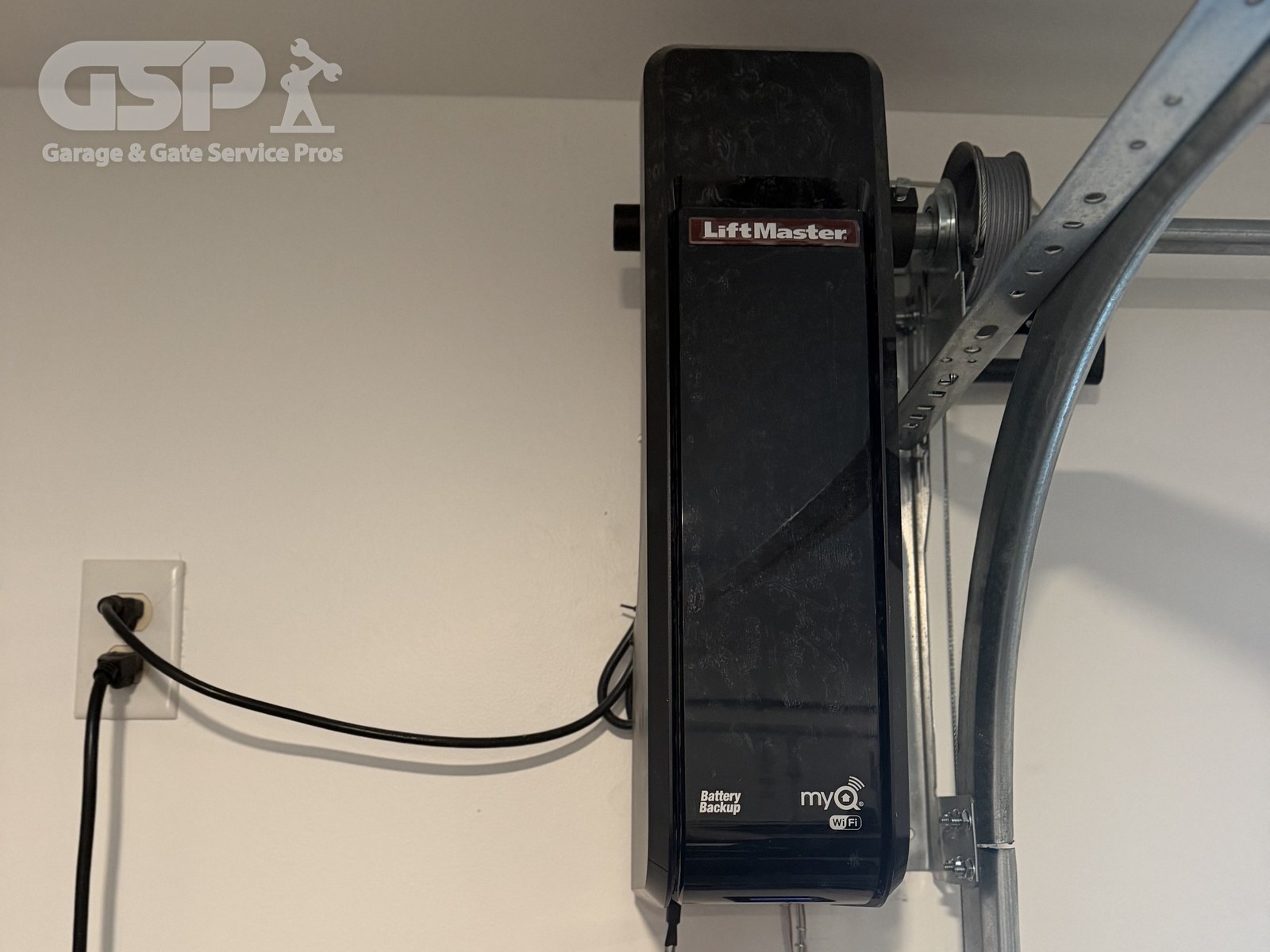
Here is the 98032 we installed, from our own job footage:
A LiftMaster 98032 wall-mount opener we installed for a Houston-area homeowner. The opener sits beside the door, and the ceiling stays clear.
Why homeowners choose a wall-mount opener
You get your ceiling back
This is the big one. In a lot of Houston-area homes, the garage is also the storage room, the workshop, and the place where holiday decorations live eleven months a year. Overhead storage racks are one of the best ways to use that space, but a ceiling opener and its rail sit right in the middle of it. With a wall-mount opener, the center of the ceiling is open for racks, a storage loft, better lighting, or a ceiling fan for those long, hot summers.
It also matters in garages with high ceilings. Some homeowners raise the door’s open height to fit a tall truck or a car lift. A ceiling opener needs a long rail and hardware hanging down from a high ceiling, while a wall-mount opener does not care how tall the room is. And plenty of homeowners simply like the look: with no rail or motor box overhead, the garage feels bigger and more finished.
It runs quieter
Because the motor turns the torsion bar directly, there is no long chain or belt running across the ceiling, and no trolley sliding down a rail. LiftMaster describes the 98032 as ultra-quiet. With less hardware attached to the ceiling, that can make a real difference if you have a bedroom, game room, or office over the garage.
Modern features built in
The LiftMaster 98032 we installed is Wi-Fi enabled, so you can open, close, and check the door from your phone with the myQ app. It also has battery backup, an automatic garage door lock, and a remote LED light. Features vary by model, so compare before you choose.
Is your garage a good fit?
A wall-mount opener is a great fit for many garages, but not all of them. Here is what we look at before recommending one.
- Torsion springs above the door. Wall-mount openers work by turning the torsion bar, so your door needs a torsion spring system. LiftMaster’s own guide for the 98032 says it is for sectional doors with torsion assemblies only. If your door uses extension springs, the long springs that run along the horizontal tracks on each side, a wall-mount opener is not designed for it as-is.
- The right track setup. LiftMaster also notes the 98032 is not intended for low headroom tracks with an outside pickup drum. Our technician will look at your track and drums before recommending a model.
- Wall space and power. The opener mounts on the side wall at the end of the torsion bar, so that spot needs to be clear, and there needs to be a way to get power to it. Shelving, water heaters, or a side door in that spot can change the plan.
- Door weight. LiftMaster rates the 98032 for doors from 400 to 1,100 pounds, depending on setup. That is a wide range, but your technician should confirm the fit for your specific door.
- A healthy, balanced door. Any opener, wall-mount or ceiling, should only move a door that is already balanced and working well. If your springs are worn, cables are frayed, or the door is heavy to lift by hand, those problems need to be fixed first.
When a ceiling opener still makes sense
If you do not need the ceiling space, a good belt-drive or chain-drive ceiling opener is still a solid choice, and many models also offer battery backup and Wi-Fi. It may also be the simpler path if your door uses extension springs. The right opener is the one that fits your door and how you use the space.
When the power goes out
Hurricane season runs through November, so this is a good time to know exactly what your opener does without power. You have two tools: battery backup and the manual release.
Battery backup
If your opener has battery backup, it can keep opening and closing the door during an outage. For the 98032, LiftMaster says the battery supplies up to 24 hours of operation during a power outage. That is LiftMaster’s rating, and real-world results depend on how often you use the door and the condition of the battery.
Running on battery is not quite the same as running on house power. According to LiftMaster, when the opener is on battery:
- The door runs slower than normal.
- The opener lights stay off.
- Timer-to-Close and closing the door remotely from the myQ app are turned off.
- The automatic garage door lock unlocks when the door opens and stays disabled until power comes back.
A slow door and a dark opener during an outage are normal. They mean the battery is doing its job.
How to test your battery backup
Batteries wear out, and the worst time to find out is during an outage. LiftMaster recommends testing the battery backup once a year. Here is the test, based on LiftMaster’s instructions:
- Unplug the opener from the outlet. The battery status light should turn solid orange, which means it is running on battery. A flashing orange light means the battery is low.
- Open and close the door with the remote or wall control. It should move, just slower than usual.
- Plug the opener back in. The battery light should blink green, which means the battery is charging.
If the door will not run on battery, or the status light shows solid red, the battery likely needs to be replaced. Better to find that out on a calm, sunny afternoon than during an outage.
Wondering what that backup battery actually looks like? This short clip from one of our jobs shows the battery coming out of a ceiling-mount LiftMaster opener. It is a different opener from the wall-mount 98032 above, and battery placement varies by model.
A look at the backup battery inside a garage door opener: a LiftMaster backup battery being removed from a ceiling-mount opener on a GSP job.
The manual release
Every garage door opener, wall-mount included, has a manual release, usually a red handle on a cord. Pulling it disconnects the door from the opener so you can move it by hand. With no battery backup, or a dead battery, this is how you get your car out.
LiftMaster’s safety guidance is clear on a few points:
- Use the release only when the door is closed, if at all possible. A weak or broken spring or an unbalanced door can make an open door fall fast and without warning.
- Make sure the doorway is clear of people and objects before you pull it.
- Never use the release handle to pull the door open or closed.
On the 98032, you pull the release handle down until you hear a click, and then you can lift the door by hand. To reconnect, pull the handle straight down a second time until it clicks. The door reconnects the next time the opener runs up or down. For a full walkthrough, see our guide on how to use your garage door’s manual release.
One important warning: if the door feels very heavy when you try to lift it, stop. A properly balanced door should lift with moderate effort. A door that feels like it weighs a ton usually has a broken or worn spring, and forcing it can cause injury. That is a job for garage door spring repair, not for muscle.
Have a driveway gate too? Gates have their own backup options. Learn more about driveway gate battery backup.
What a proper installation looks like
A wall-mount opener is not a DIY project. LiftMaster states the 98032 is intended for installation only by trained garage door technicians, and the install may require adjustments to the door springs or track. Here is what a good installation includes:
- Inspect the door first. Springs, cables, drums, rollers, hinges, and track all get checked, and the door gets balanced. An opener should never be used to cover up a door problem.
- Mount, connect, and program. The opener is secured to the wall and connected to the torsion bar, and the open and close limits and force settings are set for your door.
- Install the safety sensors and wall control. The photo eyes go near the floor on each side of the door, aligned and tested, and the wall control goes within easy reach.
- Test the safety reversal. The door must stop and reverse when something is in its path.
- Set up the extras. Remotes, Wi-Fi and the myQ app, and battery backup are set up and tested.
- Walk you through it. We show you the manual release and the battery test before we leave.
As an authorized LiftMaster dealer, we can help you compare models and pick the right one for your door. You can see more on our LiftMaster garage door openers page.
Every new opener installation from Garage & Gate Service Pros includes a 90-day labor warranty, and every job we do carries at least a 30-day labor warranty under the GSP Guarantee. Parts are covered by the manufacturer’s warranty.
Already have an opener that is acting up?
Not ready to replace your opener? We repair all makes and models. If yours hums but will not move the door, or the remote only works some of the time, our garage door opener repair team can find the cause and tell you honestly whether a repair or a replacement makes more sense.
Common questions
Will a wall-mount opener work on my garage door?
If your door has a torsion spring above the opening and a standard track setup, there is a good chance it will. Doors with extension springs or certain low headroom track setups may not be a fit. A technician can tell you quickly after looking at your door.
How long does the battery backup last?
For the 98032, LiftMaster says the battery supplies up to 24 hours of operation during an outage. The door runs slower and the opener lights stay off while it is on battery. Test it once a year by unplugging the opener.
Can I install a wall-mount opener myself?
LiftMaster says the 98032 is meant to be installed by trained garage door technicians, and the job can involve spring and track adjustments. Springs and cables are under high tension, so this is one to leave to a pro.
Do you install wall-mount openers outside Houston?
Yes. We serve homeowners throughout the Houston area, and our home base is in Conroe. See our Houston garage door repair and Conroe garage door repair pages for more about the areas we serve.
Thinking about a wall-mount opener?
If you want your ceiling back, a quieter door, or an opener that keeps working when the power goes out, a wall-mount opener is worth a look. Garage & Gate Service Pros has served the Houston area since 2012, we have over 500 verified reviews, and we are an authorized LiftMaster dealer. We will look at your door, tell you whether a wall-mount opener is a good fit, and walk you through your options.
Call us at 281-928-1837 and we’ll get you scheduled as soon as possible, request service online, or email support@garageservicepros.com.