

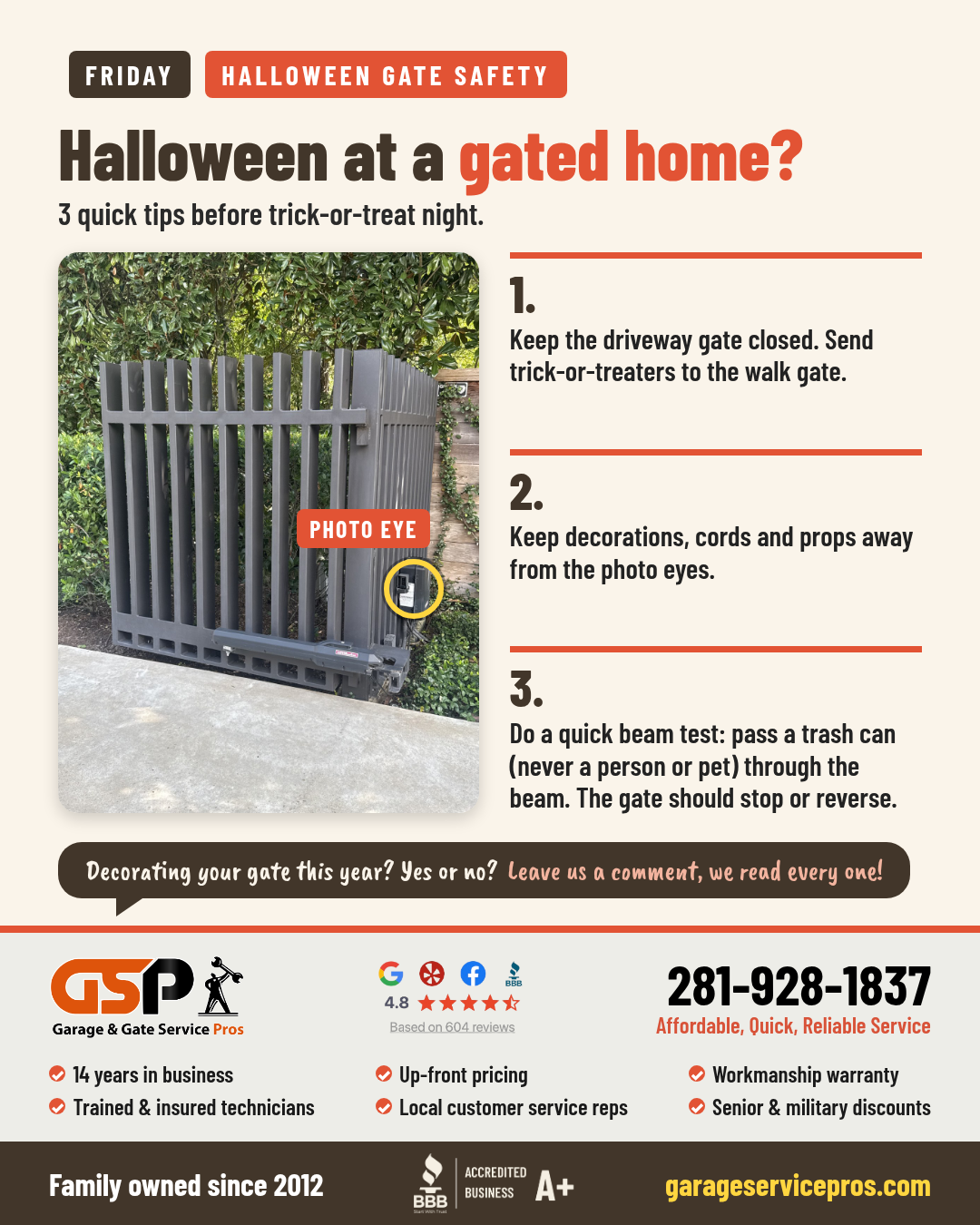
Halloween is one of the best nights of the year on any street in the Houston area. Kids in costumes, parents with flashlights, wagons and strollers rolling down the sidewalk, and a lot of people walking right past your driveway.
If you live behind an automatic driveway gate, you have one more thing to think about that most of your neighbors do not: a heavy, motor-driven gate that opens and closes on its own. On a normal evening that is no big deal. On Halloween, with little ones moving fast and not always looking where they are going, it is worth a few minutes of prep.
Here are three simple tips from our gate techs, why each one matters, and when it makes sense to call a pro instead of handling it yourself.
Why Halloween is different for a gated home
Most of the year, the people near your gate are you, your family, and the occasional delivery driver. They know the gate moves, and they wait for it.
Halloween flips that. For a few hours you have strangers, a lot of them small kids, walking up to your property in the dark. Many of them have never seen a gate like yours. Some will try to slip through an opening gate to reach the front door faster. Others will stop right in the gate path to look at your decorations.
At the same time, Halloween is when homeowners add things around the gate that are not there the rest of the year: inflatables, hay bales, fake tombstones, extension cords, lights, and a lot of fake cobweb. Some of those decorations end up right where your gate’s safety sensors need a clear view.
That combination is why a little planning goes a long way.
1. Keep the driveway gate closed on Halloween night
The easiest safety step is also the simplest: leave the driveway gate closed while trick-or-treaters are out.
Use the walk gate instead
If your property has a pedestrian walk gate, make that the way in for the evening. It is smaller, it does not move on its own, and kids already understand how a regular gate works. A small sign or a string of lights along the walk gate path helps point people the right way.
No walk gate? Set the candy bowl just outside the driveway gate, or sit out front with it. Kids get their candy, and nobody needs to come through the driveway at all.
Why a gate cycling all evening is a risk
Every time the driveway gate opens and closes, it is a large, heavy object moving across the driveway. If you are letting guests in, running out to the car, or opening the gate every few minutes for groups of kids, that is a lot of cycles with people close by.
Kids move quickly, they come in groups, and they are often wearing masks or costumes that make it harder to see or hear. Keeping the gate closed takes that whole risk off the table.
If you need to use the gate
If someone does need to drive in or out, have one adult watch the gate path while it moves, and wait until the gate is fully closed before you walk away. Do not let kids play near the gate or ride along on it, any night of the year.
2. Keep decorations away from the photo eyes
What photo eyes are and where they sit
Most automatic gate openers use photo eyes as part of their safety system. A photo eye is a small sensor, usually mounted on a gate post or a short stand near the gate, that sends an invisible beam across the gate path. When something breaks that beam while the gate is closing, the gate is designed to stop or reverse.
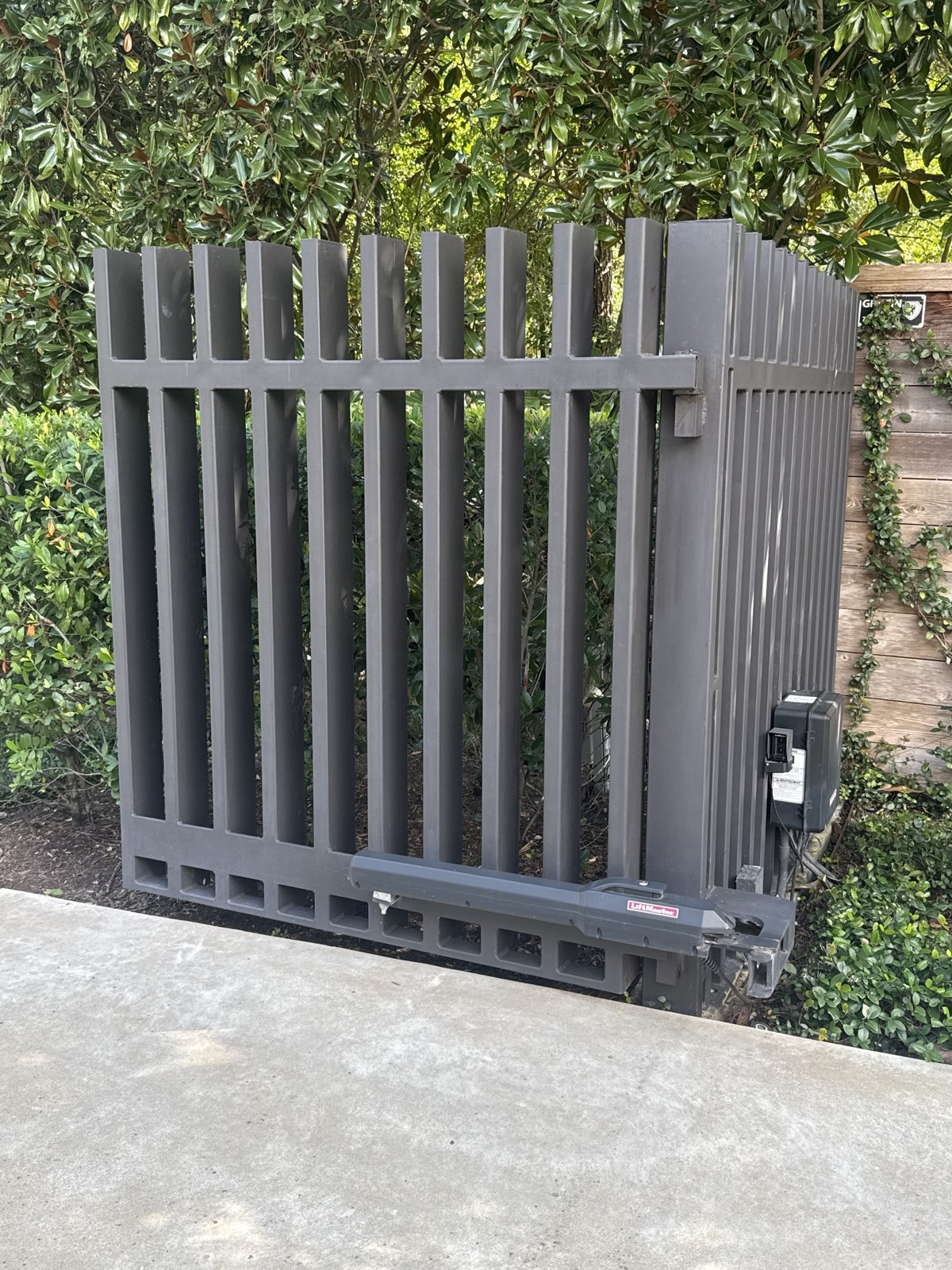
In the photo above you can see a typical setup: the operator arm at the bottom of the gate, and the photo eye mounted on the post next to it. Your gate may have one pair of eyes or several, depending on the gate type and how it was installed.
Decorations that cause trouble
Photo eyes need a clear line of sight. Halloween decorations are some of the most common things we see blocking them:
- Inflatables that sway in the wind and drift into the beam
- Fake tombstones, hay bales and pumpkins set right next to the gate posts
- Extension cords and light strings wrapped around posts or run across the driveway
- Fake cobweb stretched over the posts and sensors
- Signs or props zip-tied to the gate or the posts
Some of these block the beam completely. Others bump the sensor out of alignment, which can be just as much of a problem.
Signs a photo eye is blocked or bumped
If a sensor is blocked or knocked out of line, you may notice:
- The gate will not close, or it starts to close and then reverses for no clear reason
- The gate stops partway and will not finish
- The opener beeps or flashes an indicator light
- The gate works fine some of the time and acts up when the wind moves your decorations
The fix is usually simple: give each sensor a clear view across the driveway. Move decorations back from the posts, keep cords off the sensors, and do not hang anything on the eyes themselves. If you bumped a sensor while decorating, check that both sides are still pointed at each other.
3. Do a quick beam test before dark
Once your decorations are up, take a minute before trick-or-treaters arrive to make sure your gate still reacts the way it should.
Step by step
- Clear the gate path of people, pets and cars.
- Start the gate closing with your remote or keypad.
- While it is moving, roll a trash can or set a box into the gate opening, across the photo eye beam.
- Watch the gate. It should stop or reverse.
- Remove the object and let the gate finish its cycle.
If your gate has more than one set of photo eyes, test each one the same way.
Never test with a person or pet
Always use an object for this test. Never use a person, a child or a pet to break the beam, and never step into the gate path to see what happens. The whole point of the test is to find a problem before anyone gets close to the gate.
If the gate keeps closing
If the gate does not stop or reverse when the beam is blocked, stop using the automatic opener until it is checked. Leave the gate closed for the evening or put it in manual mode if you know how, and call a gate professional.
A gate that ignores its safety sensors is not something to put off. It may be a simple alignment or wiring issue, or it may be a problem with the sensors or the operator itself, but either way it needs a proper look.
DIY vs. calling a pro
A lot of Halloween gate prep is very DIY friendly. You can handle these yourself:
- Keeping the gate closed and pointing guests to the walk gate
- Moving decorations, cords and props away from the photo eyes
- Running the beam test with a trash can or box
- Wiping dust or cobwebs off the sensor lenses with a soft dry cloth
It is time to call a pro when:
- The gate does not stop or reverse during the beam test
- The sensors will not stay lined up, or the indicator lights stay off or keep flashing
- Wiring to the sensors is loose, chewed or damaged
- The gate stops, reverses, or acts up even with the path completely clear
- The operator is making new noises or moving slower than it used to
Our techs check the whole system, not just one part: the photo eyes and wiring, the operator, the power and any battery backup, and the gate hardware. A problem in one place can look like a problem somewhere else, so it pays to have someone look at everything together. If your gate opener itself is getting older, our article on driveway gate repair vs. replacement can help you think through your options.
After Halloween
When the decorations come down, take one more look around the gate:
- Make sure nothing was left zip-tied to the posts or near the sensors
- Check that cords are gone from the driveway and the gate path
- Run the beam test one more time, especially if a sensor was bumped during cleanup
Then you are set for the rest of the season, including the holiday decorations that usually go up next.
Frequently asked questions
Can I leave my driveway gate open on Halloween?
You can, but it is not the safer choice. An open gate invites trick-or-treaters to walk through the gate path, and the gate may close while they are in or near it. Keeping it closed and using the walk gate is simpler and safer.
What does a gate photo eye do?
A photo eye sends an invisible beam across the gate path. If something breaks the beam while the gate is closing, the gate is designed to stop or reverse. It is one of the main safety features on most automatic gate openers.
How do I know my photo eyes are working?
Run a beam test. Start the gate closing and roll a trash can or set a box across the beam. The gate should stop or reverse. Never use a person or pet for this test.
Can Halloween decorations damage my gate sensors?
Decorations usually do not damage the sensors, but they can block the beam or knock a sensor out of alignment. Cords wrapped around posts can also pull on sensor wiring. Keep decorations back from the posts and off the sensors.
What should I do if my gate does not stop during the test?
Stop using the automatic opener and leave the gate closed until it is checked. Then call a gate professional to look at the sensors, wiring and operator.
Do you work on driveway gates in the Houston area?
Yes. We work on residential driveway gates across the Houston area, including swing gates, slide gates and gate openers. See our Houston gate repair and residential gate repair pages.
*This article is general safety information. Always follow your gate opener manufacturer’s instructions, and call a gate professional if your gate is not working the way it should.*
Need your gate’s safety sensors checked?
Garage & Gate Service Pros is a family-owned company serving the Houston area since 2012. We are BBB A+ accredited, with over 800 reviews from our customers, and we offer senior and military discounts.
If your gate did not pass the beam test, or you just want a second set of eyes on it before the holidays, we can help with gate opener repair, swing gate repair, slide gate repair and more.
Call us at 281-928-1837 and we’ll get you scheduled as soon as possible, request service online, or email support@garageservicepros.com.
Happy Halloween from our family to yours.